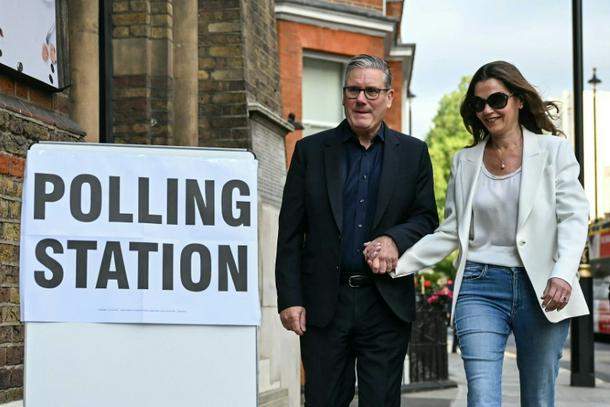
Starmer is facing his biggest electoral test since his July 2024 general election landslide victory ended 14 years of Conservative rule
London (AFP) - Britons voted Thursday in local elections set to heap more pressure on beleaguered Labour Prime Minister Keir Starmer and energise the rise of hard-right and left-wing populists.
The ballot across Scotland, England and Wales is Starmer’s biggest electoral test since his July 2024 general election landslide victory over the Conservatives.
Opinion polls predict grim results for Labour, which could amplify calls for Starmer, 63, to resign or face a long-rumoured party leadership challenge.
The prime minister and his wife voted at a polling station near parliament in Westminster.
Nigel Farage’s anti-immigrant Reform UK and the left-wing Greens, led by self-described eco-populist Zack Polanski, are expected to benefit from widespread disillusionment.
Melanie Garson, associate professor of politics at University College London, said the vote was a “huge barometer for how the country is feeling about this political establishment”.
“We’ve got, for the first time, significant pressure on the main political parties across every single council.”
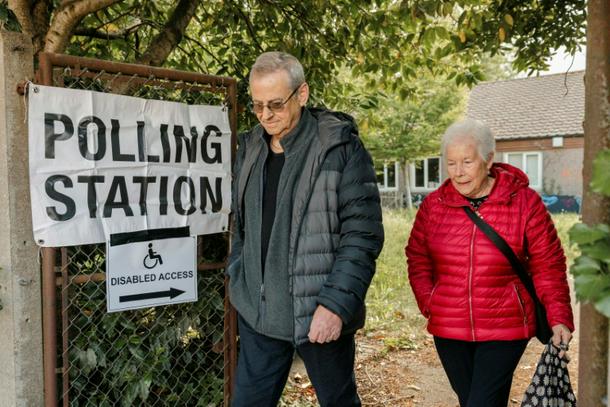
People leave after voting at the Duke's Meadow Community Centre polling station in Chiswick Homefields ward, west London, with several boroughs set to change hands
Polls will close at 10:00 pm (2100GMT). Some results are expected overnight, but most will not come until Friday.
Around 5,000 local council seats, out of 16,000, are up for grabs across England, while in Wales and Scotland voters will elect new devolved parliaments.
Starmer swept to power following 14 years of Conservative rule defined by austerity, Brexit and the tanking of the economy under former prime minister Liz Truss.
But critics say he has swerved from one policy misstep to another, and he has been embroiled in a scandal over Peter Mandelson, who was sacked as ambassador to Washington over his links to US sex offender Jeffrey Epstein.
Starmer has also failed to fulfil his main promise of spurring economic growth, with impatient Britons still suffering a cost-of-living crisis, including from high energy prices.
“Just everything’s an issue. Everything – housing, pay, food, everything,” one woman arriving at a London polling station told AFP, asking not to give her name.
- Leadership challenge? -
Starmer said Wednesday there was a “clear choice” in the vote. “Unity or division. Progress versus the politics of anger.”
Labour has also fought back, unearthing racist remarks by some Reform candidates and antisemitic comments by certain Green hopefuls.
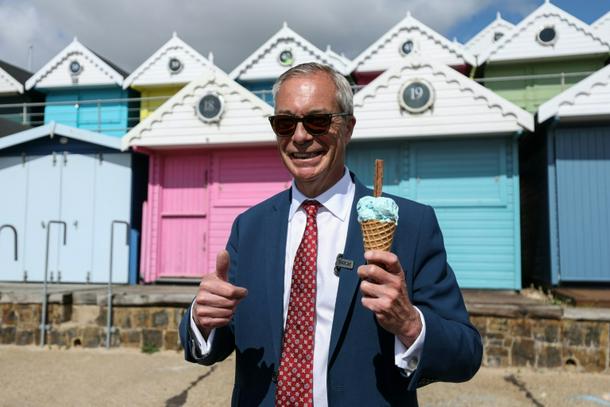
Nigel Farage, leader of the anti-immigrant Reform UK party, poses with an ice cream in eastern England, after casting his vote in the local elections
But Starmer is now one of the most unpopular prime ministers ever, and surveys suggest Labour will lose control of the devolved Welsh government in Cardiff for the first time since Wales got its own parliament 27 years ago.
A More in Common poll published Tuesday projected Reform running neck-and-neck with the pro-independence Plaid Cymru in Labour’s former heartland.
Labour is also fearful of a drubbing in Scotland, where the Scottish National Party is expected to extend its 19-year control of the devolved parliament in Edinburgh.
YouGov has predicted Reform could force Labour into third place there.
“The message is clear: if you want real change, you’d better vote for it, and we go into tomorrow feeling pretty optimistic about our prospects,” Farage said.
Labour looks set for big losses in London as the Greens pick up disaffected left-wingers in urban areas with a pro-Gaza message.
Pollster Robert Hayward has predicted the ruling party could lose about 1,850 of the roughly 2,550 local authority seats it is defending.
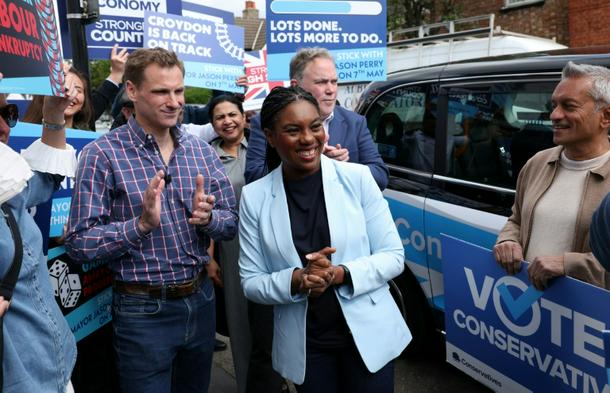
Conservative Party leader Kemi Badenoch says the two-party system in the UK has disappeared
Hayward has tipped Reform to take 1,550 seats from Labour and Kemi Badenoch’s right-wing Conservatives – mostly in white, working-class areas. The Conservatives are also bracing for the loss of traditional strongholds.
“The two-party era has moved into a multi-party era,” Badenoch told PA news agency. “But the fact is none of these new parties or Labour have a plan for the country.”
Britain’s media is full of rumours that ex-deputy prime minister Angela Rayner or Health Secretary Wes Streeting could try to oust Starmer after the results.
Neither is universally popular within Labour, however, and would need the backing of 20 percent of the party’s MPs to launch a contest.
Outside a polling station in Edinburgh, Mike Coates, 85, expressed some sympathy for Starmer, who has spent much of his premiership being buffeted by President Donald Trump, particularly over the wars in Iran and Ukraine.
“He heads a big party and it’s difficult to keep it all together, and he has faced things abroad that are very difficult. By and large, I think he’s doing okay,” the retiree told AFP.
Some Labour lawmakers are reportedly planning to demand that Starmer set a date for his departure.
But he has insisted he will lead the party into the next general election, likely in 2029.